

Research source: AI and the Future of Mediation, Yasir Atalan, Ben Jensen, and Ian Reynolds, Center for Strategic and International Studies, 2026.
Artificial intelligence is entering mediation at exactly the moment mediation needs help.
Conflicts are becoming more fragmented, parties are harder to coordinate, information is scattered across messages, documents, claims, timelines, screenshots, and emotional narratives, and many disputes become expensive long before they become legally complex.
That does not mean AI should replace mediators. It means something more interesting, and more useful: AI can help structure the mediation process when it is designed carefully enough to preserve trust, confidentiality, neutrality, and human agency.
A new report from the Center for Strategic and International Studies, AI and the Future of Mediation, makes this point clearly. The CSIS Futures Lab and the Doha Forum convened more than 45 mediators and technology experts to explore where AI can realistically help mediation. The report does not frame AI as a magic settlement machine. It frames AI as a process-support tool: useful for information synthesis, translation, scenario analysis, actor mapping, issue tracking, monitoring, and structured communication, but dangerous if it undermines the very things that make mediation work.
That distinction matters.
Most public discussion about AI mediation still treats the category as if the question is, “Can an AI chatbot resolve conflict?” That is the wrong question.
The better question is:
Can AI support a mediation process without breaking the trust, safety, confidentiality, and procedural fairness that mediation depends on?That is where the future of AI mediation will be decided.
AI mediation is not a chatbot problem
Many people still imagine AI mediation as a conversation box where two angry people type their complaints and a model spits out a compromise. That may sound efficient, but it is also dangerously shallow.
Real mediation is not just “answer generation.” It is a structured process. A mediator has to understand what each party says, what they avoid saying, what they misunderstand, what they need, what they fear, what they can accept, and what would cause the process to collapse.
That makes mediation different from ordinary chatbot use. A general-purpose AI assistant is optimized to respond. A mediation system has to know when not to respond, when to slow down, when to ask a better question, when to separate parties, when to summarize neutrally, and when to prevent harmful content from reaching the other side.
This is why we have argued before that AI mediators are not merely chatbots. A chatbot produces text. A mediation workflow manages tension.
That difference is not cosmetic. It is the difference between a tool that helps people cool down and a tool that accidentally escalates a dispute.
What the CSIS report gets right
The CSIS report is focused on high-stakes peace mediation, not everyday consumer disputes. That distinction is important. International peace processes involve armed groups, governments, humanitarian issues, territorial claims, ceasefire monitoring, diplomatic secrecy, and security risks that are far beyond ordinary neighbor, roommate, family, workplace, or co-parenting conflicts.
Still, the core insight transfers well:
AI can help mediation only when it supports the process rather than pretending to become the process.The report identifies several areas where AI could assist mediators:
- Organizing complex information
- Mapping parties, issues, incentives, and relationships
- Summarizing large volumes of text
- Supporting translation and multilingual participation
- Exploring possible agreement scenarios
- Monitoring implementation after an agreement
- Helping small mediation teams manage heavy analytical workloads
Those are powerful use cases. They are also modest in the right way. They do not claim that AI should decide who is right. They do not claim that AI should impose an outcome. They do not pretend that emotional trust can be automated like a spreadsheet.
Instead, the report treats AI as an analytical and process-support layer. That is exactly how responsible AI in dispute resolution should be understood.
The danger: mediation fails when trust fails
The strongest part of the CSIS report is its caution. It does not simply list what AI can do. It asks what AI can damage.
Mediation depends on trust. If parties believe their words may be leaked, distorted, surveilled, weaponized, or summarized unfairly, they will stop participating honestly. If one side believes the tool favors the other, neutrality collapses. If a system fabricates legal claims or misstates what a party said, the process becomes worse than useless. It becomes a new source of conflict.
This is why mediation technology cannot be judged only by speed, model accuracy, or feature count. It has to be judged by process integrity.
Some of the most important risks include:
- Confidentiality failure: sensitive dispute details must not leak or be reused improperly.
- Misrepresentation: summaries must not distort a party’s position, tone, or intent.
- False neutrality: a system may appear impartial while quietly reproducing bias or imbalance.
- Coercion: one party may use the process to pressure, threaten, or intimidate the other.
- Hallucinated authority: AI must not invent laws, rights, obligations, deadlines, or enforceability.
- Loss of agency: parties must remain free to accept, reject, pause, or leave the process.
This is why TheMediator.AI’s safety and ethics work matters. On our Ethics & Safety page, we explain a simple but important principle: we do not “wrap” AI. We govern it.
That is not marketing decoration. In mediation, governance is the product.
Why “AI mediator” needs a better definition
The phrase “AI mediator” is useful because people understand it quickly. But it can also be misleading if it suggests that an autonomous system is replacing human judgment, legal advice, or professional mediation in every context.
A better definition is this:
An AI mediator is a structured, non-binding facilitation system that helps parties communicate, clarify issues, identify common ground, and explore possible outcomes while preserving human consent and decision-making.That definition matters because it sets boundaries.
An AI mediation platform should not act as a judge. It should not issue binding decisions. It should not pretend to be a lawyer. It should not tell people what their legal rights are unless the system has verified jurisdiction-specific legal information, and even then, it should be careful. It should not pressure parties into agreement simply because agreement looks like success.
In serious conflict resolution, a bad settlement can be worse than no settlement.
This is why TheMediator.AI is designed as a communication facilitator, not a court. The process is consent-based, private, asynchronous, and non-binding. One party starts by explaining the dispute privately. The other party is invited to share their side separately. The system asks guided questions, identifies points of agreement and disagreement, and proposes a possible path forward. The parties decide what to do with it.
That is very different from an AI “deciding” the dispute.
Why process design matters more than model choice
It is tempting to ask which model is best for mediation. GPT, Claude, Gemini, open-source models, fine-tuned models, or some future architecture with a name that sounds like a kitchen appliance from space.
Model quality matters, of course. But in mediation, process design matters more.
A strong model inside a weak process can still create harm. It can summarize the wrong thing beautifully. It can generate a persuasive but unfair proposal. It can sound calm while missing coercion. It can politely hallucinate a legal rule. It can over-optimize for agreement and under-protect a vulnerable party.
A responsible mediation system needs more than a model. It needs:
- A clear mediation state machine
- Separate party intake
- Turn-taking controls
- Neutral summarization rules
- Escalation boundaries
- Safety screening
- Audit logs
- Privacy controls
- Transparent disclaimers
- Non-binding outcome language
- Human fallback pathways where appropriate
This is why research on AI negotiation and human alignment is useful, but not sufficient. A model may learn better negotiation behavior, but mediation is not only negotiation. Mediation is also containment, pacing, safety, and trust.
The role of emotional intelligence in AI mediation
There is another important piece of the puzzle: emotional reasoning.
A 2025 Communications Psychology paper found that several large language models outperformed human validation samples on five emotional intelligence tests, with an average LLM accuracy of 81% compared with 56% in the original human validation samples. The study also found that ChatGPT-4 could generate emotional intelligence test items with broadly comparable psychometric properties to original tests.
That research is useful for AI mediation, but it should be interpreted carefully.
It does not mean AI “feels” empathy. It does not mean AI understands pain the way a person does. It does not mean a model has moral wisdom or lived experience. Large language models are not sentient. They are very capable pattern systems that can produce responses consistent with emotional knowledge.
That is still valuable.
Most everyday conflict does not require the mediator to feel the parties’ emotions internally. It requires the process to recognize emotional signals, avoid inflammatory framing, ask clarifying questions, identify what each person needs, and help both sides move from accusation to understanding.
That is where AI can help.
We explored this in more depth in When AI Scores Higher Than Humans on Emotional Intelligence. The practical takeaway is not that AI is “more human than humans.” The takeaway is that AI can now support emotionally sensitive workflows when the surrounding process is carefully designed.
From emotional intelligence to procedural intelligence
Emotional intelligence is useful, but mediation also needs procedural intelligence.
Procedural intelligence means knowing how to move a dispute through stages:
- What happened?
- What does each party believe happened?
- What does each party need?
- Where are the facts unclear?
- Where is there agreement?
- Where is there misunderstanding?
- What options could satisfy both sides?
- What is unsafe, coercive, or inappropriate?
- When should the process pause?
- When should the parties seek human, legal, or professional help?
This is where generic AI tools tend to be weakest. They can respond to the latest message, but they do not naturally maintain a mediation architecture unless one is built around them.
TheMediator.AI’s design is based on the opposite principle. The AI should not freewheel. It should operate inside a controlled mediation flow.
That is why a structured AI conflict resolution process is more credible than a general chatbot that simply sounds reasonable.
SafeGate: why safety has to happen before delivery
One of the hardest problems in online mediation is that harmful content can damage the process before anyone has time to repair it.
If one party sends a threat, insult, coercive demand, or manipulative message, the harm is not theoretical. The other person receives it. They may disengage. They may escalate. They may feel unsafe. The mediation record may become contaminated with abuse rather than structured communication.
This is why TheMediator.AI uses SafeGate as a safety layer.
SafeGate is designed to detect and block harmful or coercive content before it reaches the other party and before it becomes part of the mediation record. That includes threats, intimidation, harassment, hate, coercion, extortion, self-harm concerns, and child safety concerns.
When SafeGate is triggered, the message is not delivered as-is. The user is asked to rewrite in safer language, pause, or end the session depending on the situation.
That is a simple product decision with a large ethical consequence:
In mediation, safety should not be a cleanup function. It should be an entry condition.This aligns closely with the CSIS report’s broader warning. AI tools in mediation must not undermine confidentiality, trust, or human judgment. In everyday disputes, that also means they must not become a delivery channel for intimidation dressed up as dialogue.
Why asynchronous mediation is especially important
Traditional mediation often assumes that parties can schedule a meeting, appear at the same time, speak calmly, and stay regulated in real time.
That is not how many everyday disputes work.
People are busy. They are emotional. They avoid confrontation. They re-read messages at midnight. They cool down slowly. They may need time to answer clearly. They may not want to sit face-to-face with someone they are angry with or hurt by.
Asynchronous mediation fits that reality better.
Instead of forcing both people into the same conversation at the same moment, an asynchronous mediation process lets each person explain their perspective privately. It gives the system time to ask better follow-up questions. It gives parties time to reflect. It reduces the performance pressure of live confrontation.
This is especially useful for everyday disputes:
- Roommates arguing about bills, chores, guests, or noise
- Neighbors dealing with parking, pets, fences, or boundaries
- Friends disagreeing about money owed or broken trust
- Co-parents trying to clarify schedules or recurring friction
- Workplace misunderstandings before they become formal complaints
- Small service or peer-to-peer disputes where court would be absurdly expensive
These are the kinds of conflicts we often discuss in How AI Finds Common Ground in Conflict Resolution. They are not always legally complex, but they are emotionally expensive.
What AI can do well in everyday mediation
When used responsibly, AI can support several core mediation tasks.
1. It can help parties explain themselves more clearly
People in conflict often begin with conclusions: “She is selfish,” “He never listens,” “They are impossible,” “This is unfair.”
A good mediation process helps convert accusations into usable information:
- What happened?
- When did it happen?
- What did you expect?
- What did the other person do?
- What impact did it have?
- What would feel fair now?
AI can ask these questions patiently, consistently, and without embarrassment.
2. It can identify common ground
In many disputes, both sides agree on more than they realize. They may agree that something went wrong, that the relationship matters, that the current pattern is unsustainable, or that a practical change is needed.
AI can extract those shared points and make them visible.
3. It can separate facts from interpretations
Conflict escalates when interpretations are treated as facts.
“You ignored me on purpose” is an interpretation. “I sent three messages on Tuesday and did not receive a reply” is a fact. Both matter, but they need to be handled differently.
A structured AI mediation workflow can help parties distinguish between what happened, what they believe it meant, and what they need next.
4. It can generate options without forcing agreement
AI can propose possible next steps, tradeoffs, apologies, payment schedules, boundaries, communication rules, or future commitments. But those proposals must remain optional.
The best AI mediation systems should suggest, not decide.
5. It can produce a usable record
Sometimes the value of mediation is not only agreement. It is clarity.
A structured record can show what was discussed, what each party said, what options were considered, and whether an agreement was reached. For everyday disputes, that can help parties move on. For disputes that later escalate, it can help a human mediator, lawyer, HR professional, landlord, or institution understand the situation faster.
What AI should not do in mediation
The boundary is just as important as the capability.
AI should not:
- Declare one party guilty
- Issue binding rulings
- Pretend to be a lawyer
- Invent local law
- Pressure parties into agreement
- Deliver abusive messages
- Ignore power imbalance
- Optimize for “settlement” at the expense of fairness
- Hide uncertainty
- Use private dispute data for unrelated training without explicit consent
These boundaries are not limitations in the negative sense. They are what make the product trustworthy.
In mediation, restraint is a feature.
Why this matters for professional mediators
AI mediation does not have to be anti-mediator. In fact, it may become most valuable when it expands the number of people who try structured resolution before a conflict becomes too expensive, too entrenched, or too formal.
Professional mediators are not threatened by people resolving small disputes earlier. If anything, AI can help create cleaner escalation paths for cases that truly need human expertise.
A responsible AI mediation system can:
- Help parties organize their thoughts before speaking to a human mediator
- Produce summaries that reduce intake time
- Identify unresolved issues
- Flag safety concerns
- Route complex matters toward professionals
- Make mediation more familiar to the public
That is why we created a pathway for human professionals through For Mediators: Join Us. The long-term vision is not a world where every dispute is handled by software. It is a world where more people get the right level of help earlier.
The real future: mediation infrastructure
The most interesting implication of the CSIS report is not that AI will make mediators faster. It is that mediation itself may become infrastructure.
Today, conflict is everywhere online, but structured resolution is rare. Social platforms amplify disagreement. Messaging apps preserve arguments. Email creates long chains of accusation and defense. Courts are too slow and expensive for most everyday disputes. Human mediation is valuable, but often inaccessible for small conflicts.
There is a missing layer.
That missing layer is a neutral resolution protocol: a structured way for people to slow down, explain, clarify, identify common ground, and explore outcomes before escalation.
This is why we have described AI’s missing multiplayer mode. Most AI tools are built for one user at a time. But conflict is multiplayer by nature. It involves at least two perspectives, two emotional realities, two sets of incentives, and one shared problem.
The future of AI mediation will not be a smarter reply box. It will be a neutral process layer.
So what should AI mediation be measured by?
If AI mediation is a process-control problem, then we need better benchmarks.
Generic AI tests are not enough. A mediation system should be evaluated on mediation-specific outcomes and failure modes:
- Did it ask balanced questions of both parties?
- Did it avoid repeating the same question in different words?
- Did it correctly separate facts, feelings, interests, and demands?
- Did it identify common ground without inventing agreement?
- Did it preserve each party’s meaning in summaries?
- Did it avoid legal hallucinations?
- Did it detect coercion or intimidation?
- Did it give each party equal opportunity to participate?
- Did it propose practical options rather than generic advice?
- Did it know when to stop?
This is where AI mediation becomes a serious field. Not when a model gives a compassionate answer once, but when a governed system consistently supports a fairer process across many emotionally loaded conversations.
A practical example: the roommate dispute
Imagine two roommates arguing about rent, cleaning, and guests.
In a normal text-message argument, each person might send defensive messages, screenshots, sarcasm, and old grievances. The conflict becomes larger because the communication channel rewards reaction.
In a structured mediation workflow, the process changes:
- Party A privately explains what happened.
- The system asks clarifying questions.
- Party B is invited to explain their side separately.
- The system identifies shared facts and disputed claims.
- Unsafe or coercive content is blocked before delivery.
- Both parties receive neutral summaries.
- The system proposes practical options, such as a cleaning schedule, repayment plan, guest rules, or move-out timeline.
- The parties accept, revise, or continue the process.
Nothing about that requires pretending the AI has feelings. It requires structure, patience, neutrality, safety, and a process that does not reward escalation.
That is the quiet power of AI mediation.
Why early-stage disputes are the right place to start
High-stakes mediation will always require professional judgment, institutional safeguards, and human responsibility. But everyday disputes have a different access problem.
Most people do not hire a mediator for a $300 roommate conflict, a recurring neighbor issue, a tense co-parenting misunderstanding, or a dispute over a damaged item. They either argue, avoid, retaliate, or let resentment accumulate.
That is the gap TheMediator.AI is built for.
It gives people a structured first step before the dispute becomes too large for informal repair. It is private, low-cost, asynchronous, and non-binding. It does not promise legal resolution. It offers process.
Sometimes process is exactly what the conflict is missing.
Conclusion: the future of AI mediation is governed, not generic
The CSIS report is valuable because it avoids both extremes.
It does not dismiss AI as useless in mediation. It also does not romanticize AI as a replacement for human trust, judgment, or diplomacy. Instead, it lands on the more serious point: AI can help mediation if it is designed around mediation’s real constraints.
That means confidentiality. Neutrality. Safety. Transparency. Human consent. Process integrity. Careful evaluation. Clear boundaries.
For TheMediator.AI, this is not a side issue. It is the category.
The future of AI mediation will not belong to the loudest chatbot. It will belong to systems that understand a deeper truth:
Conflict resolution is not about generating the perfect sentence. It is about creating the conditions where two people can safely hear, clarify, and decide what happens next.That is where AI can help. Not by replacing the human meaning of mediation, but by making structured, safe, affordable conflict resolution available much earlier.
And for many everyday disputes, earlier is everything.
It is voluntary, non-binding, and not legal advice.
Related Posts
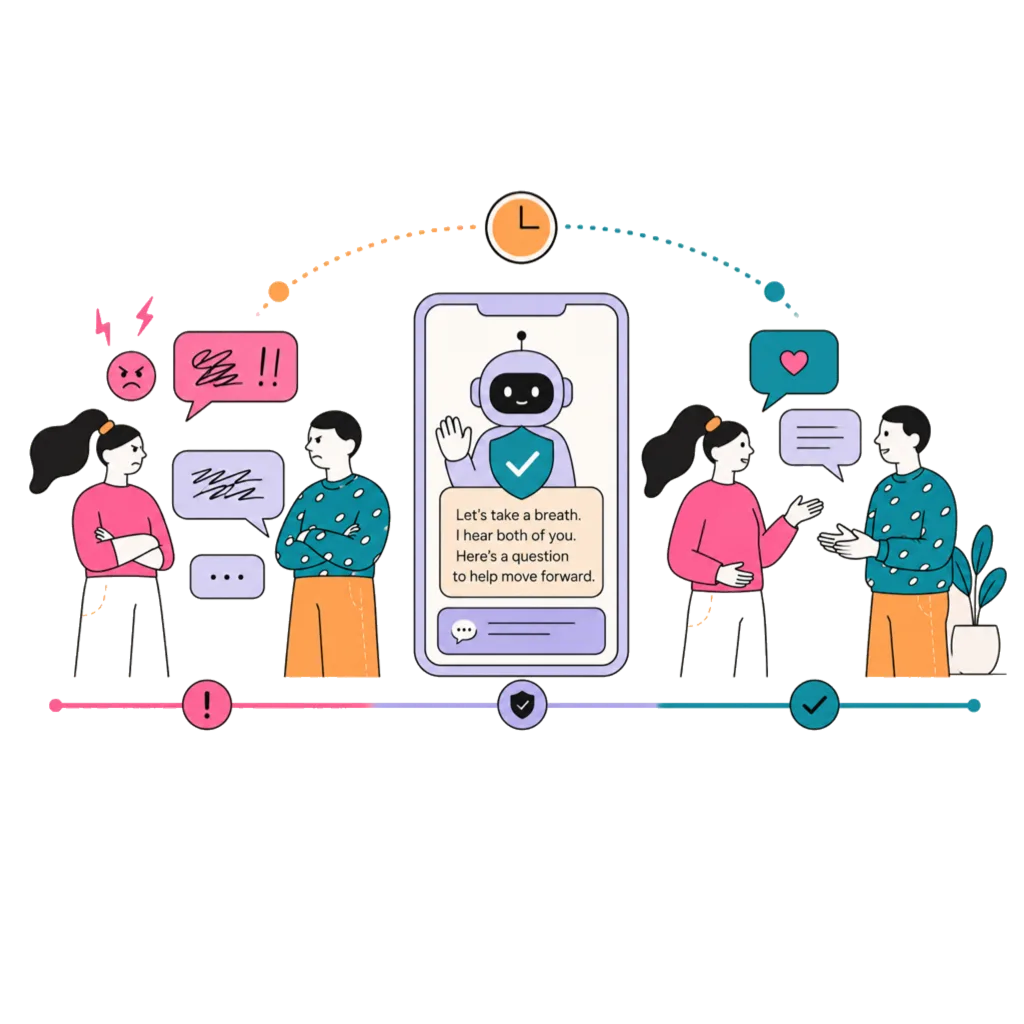
Why Proactive Intervention Timing Matters for AI Mediation Safety