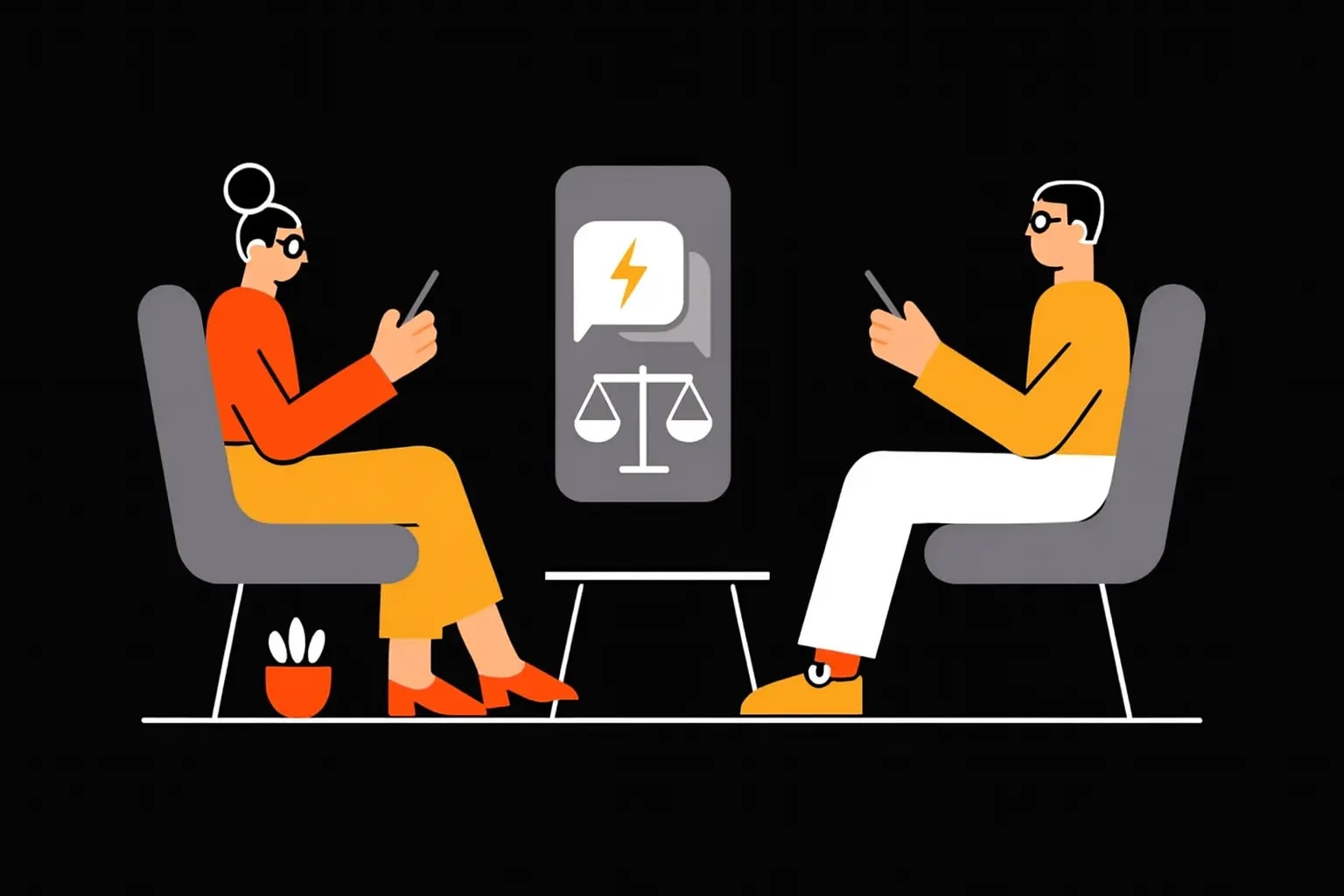

When you open a chat with today’s best AI models, it often feels like magic.
They write, summarize, even empathize. Yet all this brilliance happens in a closed loop between one human and one machine.
What happens when two people—hurt, angry, or simply not seeing eye to eye—need the AI to understand both of them at once?
That’s the multiplayer gap the current wave of generative AI hasn’t filled. And it’s exactly where TheMediator.AI steps in.
1. The Single-Player Problem of AI
Most large language models (LLMs) are designed for a single user.
They learn your intent, mirror your tone, and optimize for your satisfaction.
That’s perfect for writing code or drafting emails—terrible for resolving conflict.
Because in any real dispute, there isn’t just one truth. There are two partial ones, wrapped in emotion.
An AI assistant trained to please its user will inevitably take sides, even if subtly: by validating one narrative, soft-pedaling another, or rushing toward closure to make you “feel better.”
That’s not neutrality; it’s bias wrapped in comfort.
The world doesn’t need another persuasive chatbot.
It needs a referee that listens equally to both players.
2. Emotional Intelligence: The Missing Core Skill
A decade ago, “emotional intelligence” was something HR departments tested humans for.
Now, machines are catching up—fast.
A 2025 Nature Communications Psychology study found that LLMs outperform humans on five out of five emotional-intelligence benchmarks, scoring an average 81% accuracy versus humans’ 56%.
In plain terms: AI can now identify feelings, their causes, and constructive responses more consistently than the average person.
That doesn’t make AI empathetic in the human sense. But it does mean it can:
Detect when language signals anger or withdrawal Sense where a story leaves emotional gaps Suggest phrasing that lowers defensiveness
It’s emotional literacy at superhuman scale—and when harnessed properly, it becomes a stabilizing force in human dialogue.
3. Where the Current AI Fails: Two Minds, One Model
Imagine two people in a tense exchange: roommates over rent, co-founders over equity, or ex-partners over childcare.
Now imagine both typing separately to their own chatbots.
Each AI dutifully “helps” its owner—arming both sides with sharper arguments, not deeper understanding.
That’s the paradox: AI makes solo users feel heard, but makes groups less able to listen.
What’s missing is an AI layer that mediates between, not for, individuals.
That’s what TheMediator.AI calls the Mediation Control Protocol—a neutral architecture that holds space for disagreement and gently coordinates both perspectives without judgment.
4. Turning Conflict Into Computation
TheMediator.AI treats conflict as structured data, not chaos.
Each side privately narrates their version of events.
The system parses tone, chronology, and emotional weight—then generates a shared summary highlighting common ground and points of friction.
Follow-up questions adapt to each person’s emotional readiness, pacing the dialogue like a skilled human mediator would.
It’s a five-step flow:
Narrative collection (each side’s full story) AI-generated summary (where you agree and where you don’t) Guided Q&A (tailored questions that deepen reflection) Proposed resolution (drafted in plain, non-legal language) PDF closure (optional export or court-ready certificate)
Instead of confrontation, you get structured conversation.
Instead of escalation, you get clarity.
5. Why the Timing Is Perfect
The Conflict Resolution Solutions market is booming—projected to hit $12.8 billion by 2029, driven by workplace tension, remote-team dynamics, and mandatory pre-trial mediation laws .
Courts from California to Dubai are now requiring proof that mediation was attempted before trial .
Yet human mediators remain expensive ($200 + per hour) and hard to schedule.
Meanwhile, 90 % of interpersonal conflicts never reach professional help .
This leaves a massive, underserved space between “ignore it” and “lawyer up.”
Exactly the space where AI can help—not as judge or therapist, but as a calm, always-on facilitator.
6. Multiplayer AI: A New Social Interface
If ChatGPT represents the “single-player” era of AI, TheMediator.AI represents the multiplayer era—where the model’s goal isn’t to please either participant, but to serve the relationship itself.
Think of it as an AI-hosted room rather than an AI companion.
Inside that room:
Both users see the same neutral summaries. Neither can edit the other’s words. Emotional tone analysis ensures timing and phrasing stay constructive.
This neutral infrastructure matters.
Just as the web standardized HTTP for information exchange, TheMediator.AI is building what it calls the Mediation Control Protocol (MCP) for emotional exchange—a framework that future personal AIs could plug into when their owners disagree.
7. The Trust Equation: Privacy + Fairness + Cost
At its core, trust in mediation comes from three guarantees:
1. Privacy — Conversations are encrypted, stored on a first-name basis, and automatically deleted 30 days after resolution.
2. Fairness — The AI operates as a third party, not “your assistant.” It cannot be bribed by your tone or your prompts.
3. Accessibility — One free dispute, then a flat $4.99 per case—roughly 1/60th the cost of an hour with a human mediator.
That pricing flips the cost psychology of conflict, therefore the benefits of using AI in mediation make this possible.
When help costs less than lunch, people use it early—before resentment calcifies.
8. The Emotional ROI
Conflict avoidance is one of the world’s most expensive habits.
Friendships end, teams fracture, lawsuits begin—all because two people couldn’t find safe ground to talk.
An AI mediator doesn’t erase emotion; it gives it structure.
By transforming raw frustration into organized dialogue, it prevents what psychologists call “conflict decay”—the slide from irritation to hostility that costs relationships, jobs, and peace of mind.
And unlike human mediators, an AI one doesn’t tire, take sides, or forget the details you shared weeks ago.
9. From Tool to Infrastructure
It’s tempting to view TheMediator.AI as just an AI Mediation app.
But its larger ambition is infrastructural: to become the neutral protocol layer that other AIs use to resolve disagreements.
As personal AI agents proliferate, conflicts between them will reflect conflicts between their humans.
Your “shopping agent” and your landlord’s “lease agent” might one day negotiate rent renewals automatically—but when they hit an impasse, something still needs to referee.
That’s the long-term moat: an unbiased, explainable mediation layer—standardizable across systems, compliant with global mediation laws, and trusted by courts and consumers alike.
10. The Future of Human-Centered AI
For all its computational power, AI still struggles with something ancient: hurt feelings.
But we’re finally seeing models that don’t just calculate—they listen.
They can hold tension, reflect nuance, and suggest repair instead of victory.
TheMediator.AI doesn’t promise a world without disagreement, it acts as AI as an effective mediator..
It promises a world where disagreement doesn’t have to end relationships.
Related Posts
Can AI Mediate Human Conflict? Emotional Intelligence in AI Mediation
Read More