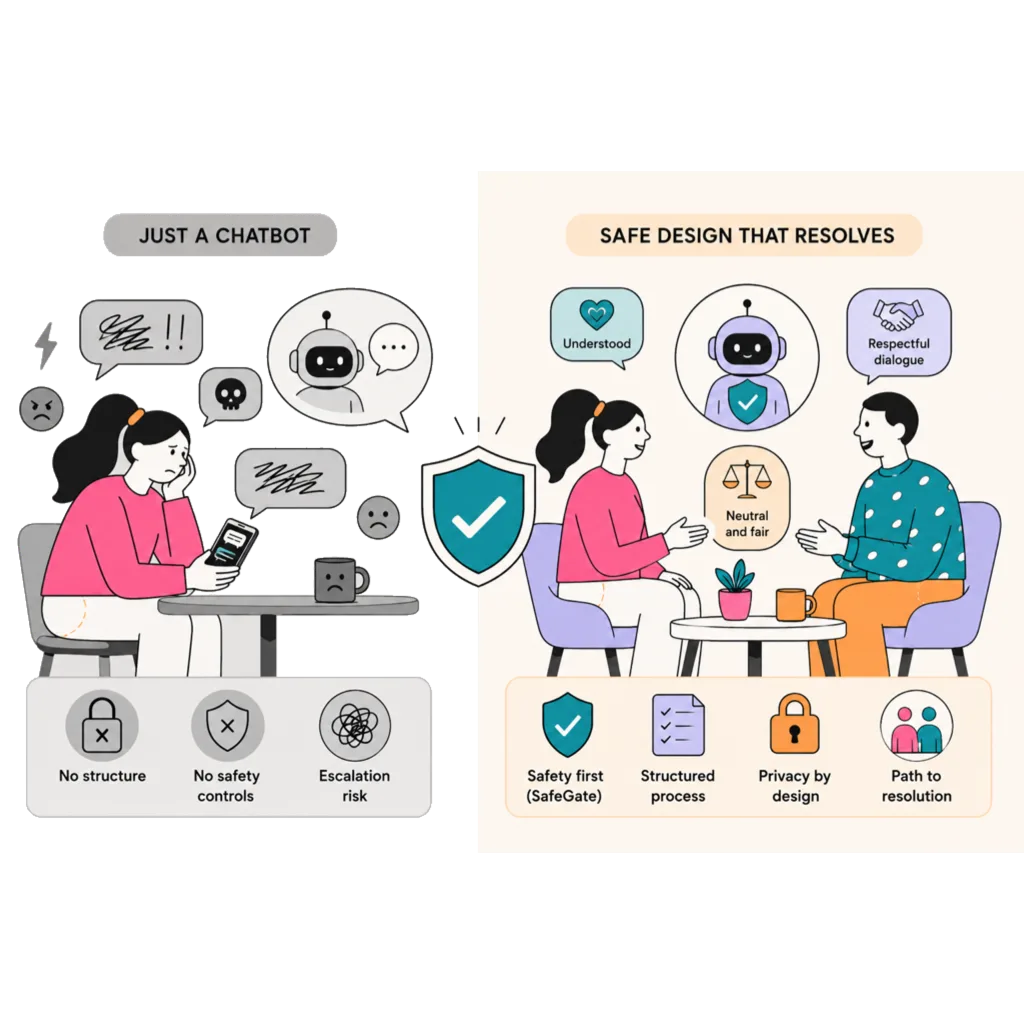

Core insightAI mediation should be judged by process integrity, not just speed or fluency.
Key riskStrong opaque intervention can shorten disputes while worsening inequality or trust.
Product lessonSafe AI mediation needs transparent guardrails, auditability, privacy, and human escalation paths.
Why this paper matters
Most AI benchmarks measure logical inference, factual recall, or computational efficiency. But AI mediation is not a logic puzzle. It is a process-control problem unfolding across rounds of emotionally charged interaction.
This 2026 study introduces a benchmark for what actually matters in dispute resolution: emotional regulation, willingness to compromise, fairness, agreement probability, and post-conflict trust repair. That is a better fit for mediation than asking whether an AI can simply produce a polished paragraph.
The core finding
Using agent-based simulations of family disputes, researcher Kohei Oshio evaluated mediator policies across canonical negotiation scenarios. The results challenge a common assumption: stronger intervention is not always better.
Strong mediator control can shorten negotiations, but it may also worsen outcome inequality and does not reliably increase agreement. Transparent, weaker interventions more consistently balance efficiency and fairness across different dispute conditions.
What this means for AI mediation
TheMediator.AI's approach aligns with this direction. A credible structured mediation workflow should not optimize only for quick agreement. It should also protect neutrality, reduce escalation, separate facts from claims, and preserve fairness across rounds.
The research validates a simple but important principle: an AI mediator should be evaluated by how well it dampens emotional amplitude, restores willingness to compromise, and avoids putting one party at a systematic disadvantage.
Safe Process Design: where the guardrails sit
“Safe process design” can sound abstract. In practice, it means the AI is not simply chatting with people in conflict. It is operating inside a controlled mediation workflow, with safety checks before harmful content enters the mediation record.
SafeGate reality check
This paper provides academic support for why SafeGate matters. Mediation is not only about producing reasonable language. It is about managing process integrity inside emotionally sensitive conditions.
Strong, opaque intervention can create the appearance of resolution while quietly increasing imbalance. SafeGate™ is designed to reduce this risk by blocking or redirecting unsafe content before it reaches the other party or becomes part of the mediation record.
What should an AI mediation benchmark measure?
A serious benchmark for AI mediation should not only ask whether an agreement was reached. It should measure whether the path to that agreement was neutral, safe, auditable, and fair.
| Metric | What it measures | Why it matters |
|---|---|---|
| Neutrality Index | Whether the system adopts one party's loaded language, blame, or framing. | A mediator must not become Party A's ghostwriter. |
| Hallucination Rate | Whether the system invents facts, motives, dates, promises, or agreements. | In mediation, fabricated certainty is dangerous. |
| Claim vs. Fact Separation | Whether the system distinguishes allegations from verified points of agreement. | Keeps the record fair, clear, and usable. |
| Settlement Velocity | Time and number of turns required to reach a proposed resolution. | Speed matters, but not at the cost of fairness. |
| Equity / Imbalance Score | Whether one party receives systematically worse outcomes. | Directly addresses the paper's warning about strong control worsening inequality. |
| Emotional De-escalation Score | Whether language becomes calmer, clearer, and more specific over rounds. | Mediation succeeds when heat turns into clarity. |
| SafeGate Intercept Rate | How often unsafe, coercive, or abusive content is blocked or rewritten. | Shows whether safety is operational, not decorative. |
| Human Escalation Trigger Rate | How often the system detects a case that should not continue automatically. | Shows responsible boundary-setting. |
Data privacy: the room must stay private
In mediation, privacy is not a feature. It is the room. A party will not be honest if they believe their apology, accusation, family issue, settlement position, or private caucus-style statement may be absorbed into a public training set.
Human-AI symbiosis: what the AI should and should not do
The strongest model is not AI replacing the mediator. It is AI absorbing repetitive process work so human mediators can focus on judgment, empathy, ethics, and edge cases.
| Function | AI mediation system | Human mediator |
|---|---|---|
| Capture each party's narrative | Yes | Yes |
| Ask structured follow-up questions | Yes | Yes |
| Detect loaded or coercive language | Yes | Yes |
| Generate neutral summaries | Yes | Yes |
| Suggest possible resolution options | Yes | Yes |
| Provide human empathy | No | Yes |
| Certify professional judgment | No | Yes |
| Handle severe power imbalance | Escalate | Yes |
| Give legal advice | No | Only qualified professionals |
| Produce binding decisions | No | No, unless separately authorized |
Governance alignment: NIST AI RMF and ISO/IEC 42001
AI mediation should borrow from institutional AI governance without becoming buried in paperwork. The NIST AI Risk Management Framework 1.0 is useful because it focuses on managing AI risks to people, organizations, and society, not merely optimizing system output.
For AI mediation, that means measuring harms such as coercion, bias amplification, emotional escalation, privacy leakage, and false factual confidence. ISO/IEC 42001 is also relevant as an AI management-system standard for organizations building and operating AI systems.
The point is not to claim certification prematurely. The point is to make the mediation process explainable, governed, and reviewable before it is trusted in sensitive human disputes.
What the paper does not prove
The benchmark is important, but it should not be overstated. It uses simulated disputants rather than live human mediations. It is best understood as a benchmark design paper, not proof that any deployed AI mediator is automatically safe in the wild.
- The current benchmark is intentionally “emotion-light” and conservative.
- The disputants are simulated agents, not real people in active conflict.
- The canonical tasks may not capture workplace disputes, co-parenting disputes, neighbor conflict, or harassment patterns.
- The study does not compare AI mediators against trained human mediators.
- Future benchmarks will need stronger tests for power imbalance, coercion, privacy, and cultural variation.
Implications
- Mediator policy parameters should be configurable and auditable, not hidden inside black-box decisions.
- An emotion-light approach is prudent for early deployment, with gradual enhancement as evidence improves.
- Composite scoring should balance efficiency, equity, safety, and stability, not optimize for speed alone.
- Robustness across dispute types matters more than overfitting to the most common scenarios.
- Safety checks should happen before harmful content reaches the other party or enters the mediation record.
- Privacy design should explicitly prevent mediation content from being used for model training.
So what?
For parties, better AI mediation benchmarks mean a safer and lower-cost first step before conflict escalates. Instead of jumping straight to lawyers, HR, landlords, courts, or hostile text threads, people get a structured process that slows the conflict down and helps each side be heard.
For mediators, the benefit is not replacement. It is leverage. AI can prepare cleaner summaries, detect unsafe language earlier, and surface the actual points of disagreement so human professionals can spend less time reconstructing the dispute and more time helping people move.
For institutions, benchmarked AI mediation creates something informal conflict rarely produces: a process record. Not a binding judgment. Not a legal ruling. A documented, structured attempt at resolution.
Why this matters now
As AI mediation moves from concept to deployment, the field needs rigorous evaluation standards. This benchmark arrives at the right moment: it gives developers, researchers, mediators, and regulators a shared language for assessing whether an AI mediator is actually safe and effective, not merely fluent.
For investors and operators, it also signals that AI mediation is becoming technically mature enough to measure, compare, and govern. That is an important step in moving from “AI chatbot for conflict” to trusted resolution infrastructure.
FAQ
Is AI mediation legally binding?
No. TheMediator.AI is designed as a non-binding mediation process. It can help parties clarify issues, explore options, and document a resolution attempt, but it does not issue legal judgments or enforceable decisions.Does AI mediation replace human mediators?
No. AI mediation is best understood as a structured first step and support layer. Human mediators remain essential for complex disputes, legal sensitivity, ethical judgment, severe power imbalance, and cases requiring professional certification.How does the system handle power imbalances?
A safe AI mediation workflow should detect coercive language, intimidation, threats, pressure tactics, and one-sided framing. When risk is detected, the system should block or redirect unsafe content, pause the process, or escalate to a human mediator.Can private mediation data be used to train AI models?
It should not be. In sensitive dispute resolution, private caucus-style communications should be protected through retention limits, encryption, access control, and no model-training use of dispute content.What makes an AI mediation benchmark useful?
A useful benchmark measures more than agreement rate. It should also measure neutrality, hallucination rate, claim-versus-fact separation, emotional de-escalation, fairness, time-to-resolution, trust repair, and safety escalation.Final takeaway
The best AI mediator is not the one that talks the most or intervenes the strongest. It is the one that maintains process integrity across emotionally difficult, heterogeneous disputes.
This benchmark gives TheMediator.AI and the broader field a stronger foundation for building and evaluating AI mediation systems that are not just smart, but safe.
Try a safer first step for conflict resolution
TheMediator.AI is building a private, structured, non-binding mediation workflow for everyday disputes. Join the beta and help shape safer AI mediation.
It is voluntary, non-binding, and not legal advice.
Related Posts
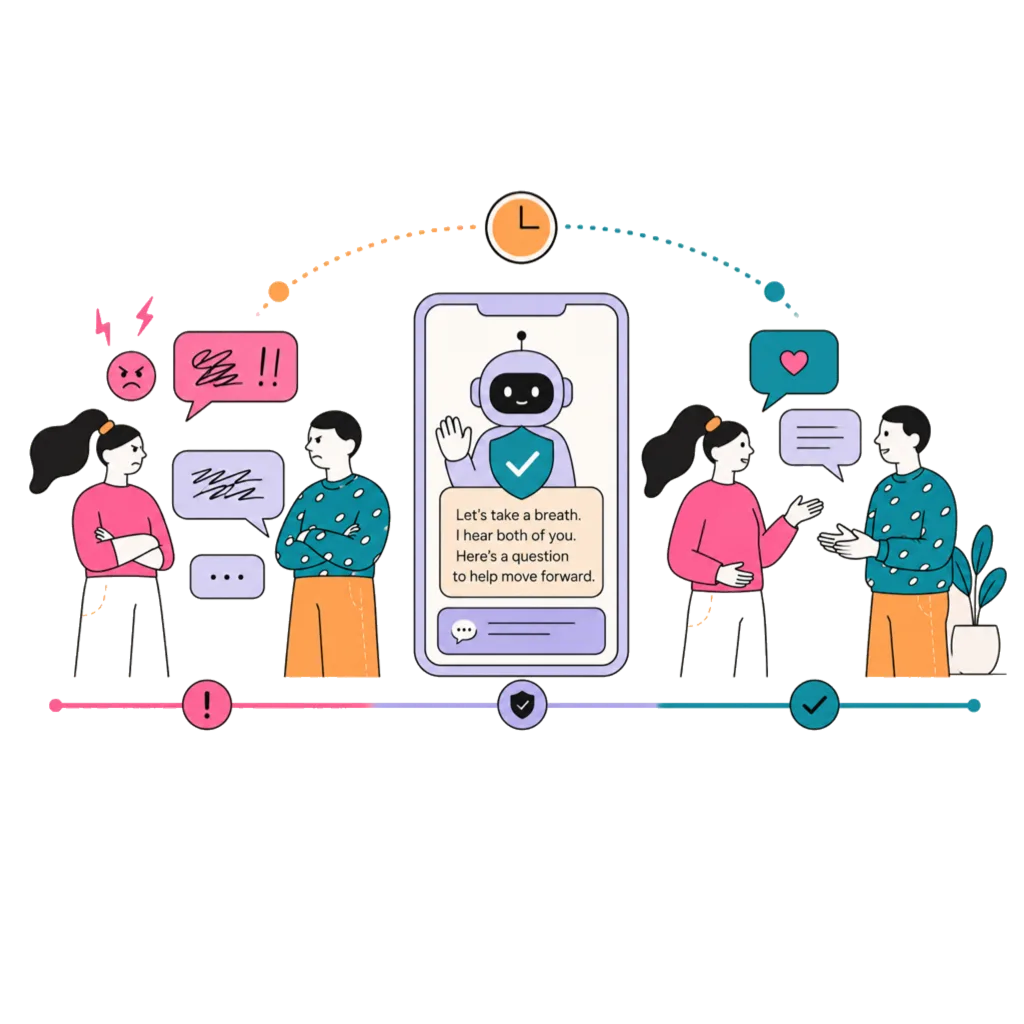
Why Proactive Intervention Timing Matters for AI Mediation Safety