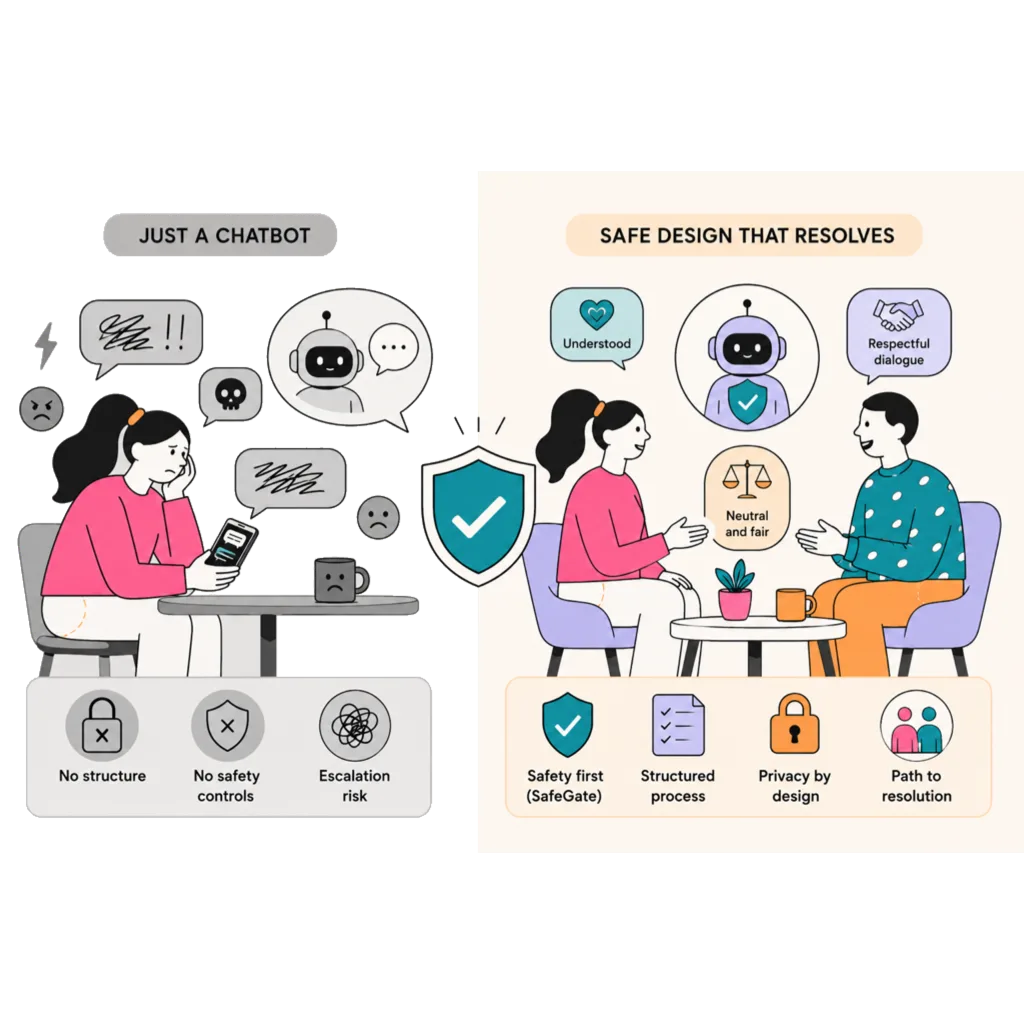

If you’ve ever argued with a roommate about bills or had a co-parenting schedule go sideways, you know one thing: when emotions run high, “just talking it out” is rarely simple.
At the same time, most of us still think of AI as a tool that spits out answers, not something we’d trust with a real dispute. A new wave of research suggests that’s changing. AI systems are starting to act less like search boxes and more like support systems – including as mediators that help people navigate conflict in calmer, fairer ways.
This is exactly the space where AI mediation apps like TheMediator.AI live.
What the new research actually says about AI support
A recent paper from computer science researchers proposes that large language models (LLMs) – the technology behind tools like ChatGPT – are moving beyond chat into four human-centered roles:
Companion – offering emotional presence and reducing loneliness
Coach – guiding skill development with feedback
Mediator – bridging gaps in access, interpretation, or communication
Curator – filtering overwhelming information into clear summaries
The key shift: instead of measuring AI only by accuracy (“Did it answer the question correctly?”), the paper argues we should measure how well it supports people over time – trust, engagement, and real-world outcomes.
In other words, the question is no longer “Can the model complete this sentence?” but:
“Does this AI actually help a stressed human move from stuck to supported?”
That’s the bar for any serious AI mediator.
The “mediator” role: more than a friendly chatbot
In this framework, the mediator role is about bridging gaps – legal, bureaucratic, linguistic, or emotional. Think of it as a translator between:
- what a person experiences,
- what a system expects, and
- what both sides actually need to move forward.
Examples from the paper include tools that help people navigate legal processes or real-time translation in multilingual conversations. The core requirement is interpretability:
- explaining complex systems in plain language,
- reducing jargon,
- and highlighting clear, next steps.
For personal disputes, that “system” isn’t just the law. It is:
- two different stories of what happened,
- two different emotional states,
- and two different ideas of what “fair” looks like.
An AI mediator’s job is to sit in the middle and make that messy picture:
1- Understandable to each person, and
2- Structured enough that a fair proposal becomes visible.
That’s very different from a generic chatbot that just gives advice to one person and never hears the other side.
Can AI really “read” emotions?
Another piece of the puzzle comes from a 2025 study in Communications Psychology. Researchers tested several leading LLMs (ChatGPT-4, Gemini, Claude, etc.) on five standard emotional intelligence tests and compared them to human performance.
- Humans scored, on average, 56%.
- LLMs scored around 81% on the same tasks.
These tests measure things like:
- understanding what someone is likely feeling in a given situation,
- choosing the most effective way to regulate an emotion, and recognizing blends of emotions from context.
Important nuance:
- This doesn’t mean AI feels anything (it doesn’t).
- It means that, when given a description of a situation, it tends to choose the same “emotionally intelligent” response that human experts would pick in standard tests.
For conflict resolution, that matters. It means an AI mediator can:
- spot when anger is really hurt,
- suggest de-escalation moves that fit the situation,
- and keep track of both parties’ concerns without taking sides.
That’s the raw ability TheMediator.AI is tapping into – then wrapping in strict design constraints so it stays safe, neutral, and useful.
Design principles for responsible AI mediation
The research paper on human-centered LLMs also lays out a set of design principles that are especially important for mediators.
Here’s how they translate into the world of AI mediation apps like TheMediator:
1. Transparency and explainability
Support systems should help you understand why they suggest a given path, not just what to do.
In practice, that means:
- plain-language summaries of each side’s story,
- clear lists of “what both of you agree on” vs “where you still differ”,
- and resolution proposals written in everyday terms, not legalese.
When you can see the logic, you can decide if it feels fair.
2. Personalization and cultural sensitivity
Conflict is never generic. The same sentence can land very differently between roommates in Montreal and co-parents in Dubai.
Human-centered LLM systems need to adapt tone, examples, and pacing to the user’s background and preferences.
For an AI mediator, that looks like:
- questions that respect how you communicate (short, private, structured),
- space for religion, culture, and family norms to be acknowledged,
- multi-language support so no one is “the disadvantaged speaker”.
3. Safety nets and guardrails
The paper is blunt about the risks: hallucinations, bad advice, over-reliance, and harm in vulnerable situations.
A serious AI mediator needs hard boundaries, like:
- refusing to coach revenge or harassment, redirecting people to emergency or in-person help in cases of abuse, danger, or self-harm, being explicit about what it cannot do (for example, replace a lawyer in a high-stakes legal dispute).
4. Memory with privacy
Good support requires continuity – remembering past messages, keeping track of the dispute, not “starting from zero” every time. But that memory must be balanced with privacy.
For a mediation app, that means:
- storing only what is needed to keep the dispute coherent,
- minimizing personal identifiers,
- and deleting conversations after resolution instead of hoarding data indefinitely (as TheMediator.AI is designed to do).
5. Balancing empathy with reliability
Over-empathetic systems can validate your feelings but give bad advice. Over-cold systems can be accurate yet feel brutal. The framework emphasizes that support systems should balance empathy with correctness.
AI mediators should:
- acknowledge emotion (“It sounds like you felt blindsided when the rent changed”),
- but stay grounded in reality (“Here are three options that could work for both of you”).
Where AI mediators make sense – and where they don’t
Given all this, where does an AI mediation app actually fit in your life?
A good fit:
- Roommate disputes (bills, chores, noise, guests)
- Neighbor issues (parking, fence lines, shared spaces)
- Co-parenting logistics (pickup times, holidays, expenses)
- Friendship friction (hurtful messages, growing distance, money lent)
- Small business or side-project disagreements (roles, profit split, expectations)
These are exactly the kinds of situations where:
- people avoid hiring a human mediator (too expensive, too awkward),
- but letting things drag on quietly can damage relationships or lead to formal disputes.
Not a good fit:
- Emergencies or situations involving violence or threats
- Cases where you need formal legal representation
- High-stakes disputes where enforceable court orders or complex law are central
In those situations, an AI mediator can sometimes help clarify your thinking, but it shouldn’t be the only support you rely on.
How TheMediator.AI fits into this new landscape
All of this research gives language for what TheMediator.AI already does in practice:
- It uses emotionally intelligent AI to understand both sides of a dispute.
- It acts as a neutral mediator, not “your” assistant, which keeps it from taking sides.
- It structures the conversation into narratives, clarifying questions, and a proposed resolution instead of a chaotic chat thread.
- It builds in privacy, deletion, and guardrails from the start, instead of treating them as afterthoughts.
Most importantly, it keeps mediation accessible:
- online,
- available 24/7,
- and affordable at a flat $4.99 per dispute, after a free first case.
If future AI is going to sit in sensitive spaces like conflict and relationships, it has to look a lot more like the “human-centered support systems” described in this research, and a lot less like a generic chatbot.
That’s the bar we’re building toward.
Next step: try an AI mediator on something small
If you’re curious but cautious, don’t start with the hardest conflict in your life.
Pick something small but real:
- a recurring annoyance with a roommate,
- a misunderstanding with a friend over money,
- or a scheduling disagreement with a co-parent.
Let an AI mediator walk both of you through:
1- sharing your side privately,
2- answer pointed questions,
3- and seeing a proposed resolution you can both react to.
You’ll know very quickly if it helps you get unstuck.
When used carefully, AI mediation isn’t about replacing human connection.
It’s about giving two people in conflict a structured, neutral space to find their way back to it.
Related Posts
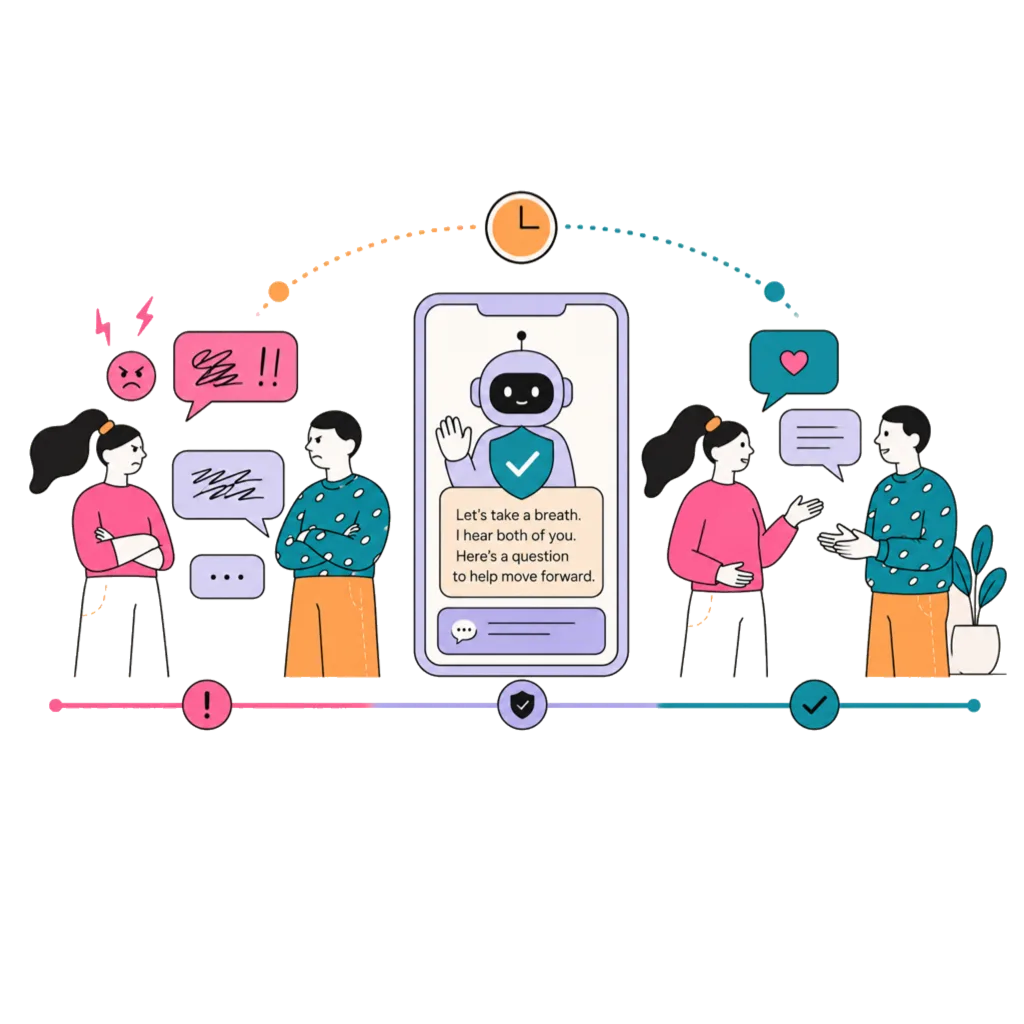
Why Proactive Intervention Timing Matters for AI Mediation Safety