

Why Proactive Intervention Timing Matters for AI Mediation Safety
Research source: Evaluating Proactive AI Mediators in Multi-Party Conversation with ProMediate, Liu et al., Microsoft Research 2026.Why this paper matters
Most AI mediation tools wait to be prompted—they're reactive. This Microsoft Research paper (April 2026) introduces ProMediate, a framework that evaluates proactive AI mediators who step in at the perfect moment to break deadlocks. The key insight: effective mediation isn't just about generating good responses; it's about knowing when to speak. This directly informs how SafeGate™ should monitor and intervene in disputes.
The core finding
ProMediate evaluates mediators across two dimensions: (1) Dynamic consensus tracking—measuring agreement scores at each conversation step, not just final outcomes; (2) Socio-cognitive intelligence—assessing perceptual differences, negative emotions, cognitive challenges, and communication breakdown. In the hardest (competitive) settings, socially intelligent mediators significantly outperformed generic baselines. They caught friction points before they hardened into deadlock. The architecture of proactivity matters as much as model size.
What this means for AI mediation
TheMediator.AI's structured mediation workflow should evolve from reactive to proactive. The paper shows that tracking consensus trajectories in real-time—and intervening when negative emotions spike or communication breaks down—is more effective than waiting for explicit prompts. This aligns with our SafeGate™ philosophy: safety layers should monitor continuously, not just respond when called.
SafeGate Reality Check
This paper is a wake-up call: reactive-only safety isn't enough. ProMediate proves that "when to intervene" is as critical as "what to say." For SafeGate™, this means: (1) Monitor consensus trajectories dynamically (not just end-state); (2) Detect negative emotion spikes, perceptual differences, communication breakdowns in real-time; (3) Intervene proactively before conflicts harden into deadlock; (4) Socio-cognitive intelligence (emotion, perception, communication) is as important as response quality for mediator agents.
What the paper does not prove
The framework uses LLM-based negotiators in simulation, not real humans in live multi-party disputes. The focus is on competitive, high-stakes negotiations; cooperative mediation dynamics need more exploration. Socio-cognitive metrics (perceptual differences, emotion tracking) are still evolving. Most importantly, the paper doesn't yet compare proactive AI mediators against human mediators in live multi-party settings—a crucial next step for deployment confidence.
- Implement dynamic consensus tracking as a SafeGate™ metric (agreement scores at each step, not just final outcome)
- Develop proactive intervention logic: monitor for negative emotion spikes, perceptual differences, communication breakdown
- Prioritize socio-cognitive intelligence in mediator agent design (emotion, perception, communication) over raw response quality
- Multi-party negotiation support should be on the product roadmap—ProMediate proves demand and provides evaluation framework
- Intervention tempo optimization: learn optimal timing from consensus trajectory data, not just rule-based triggers
Why this matters now
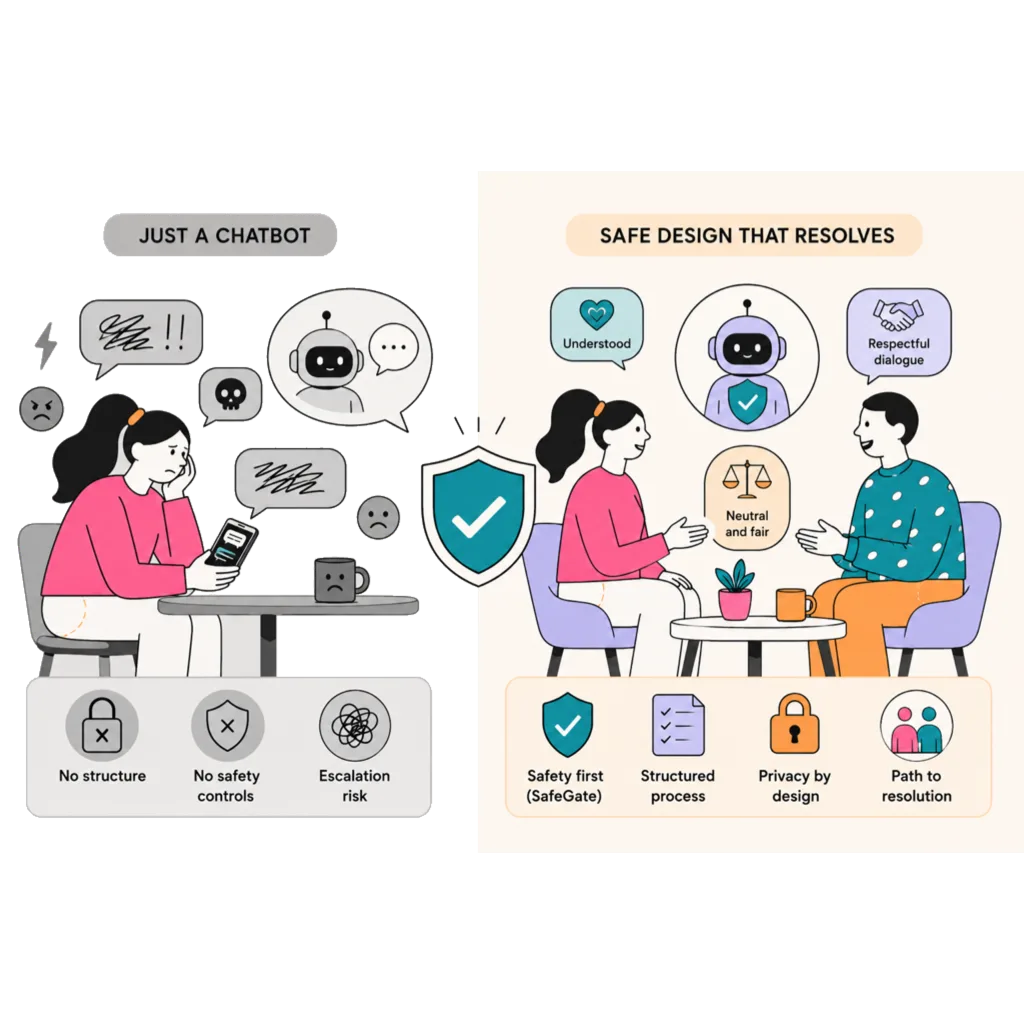
As AI mediation platforms deploy in 2026, the difference between reactive and proactive safety could determine success or failure. This Microsoft Research paper provides both the conceptual framework (ProMediate) and the empirical evidence: proactive, socio-cognitive mediators outperform generic baselines, especially in competitive scenarios. For investors and product leaders, this signals that AI mediation systems need sophisticated, timing-aware safety architectures—not just chatbots with guardrails.
Final takeaway
The best AI mediator isn't the one that writes the most eloquent messages. It's the one that knows exactly when to step in. ProMediate proves that proactive, socio-cognitive intelligence—tracking consensus in real-time and catching friction before it hardens—is what separates a chat-room bystander from a mediator that actually moves the needle. SafeGate™ is built for exactly this kind of proactive safety.
Related Posts
Why Safe Process Design Matters More Than Chatbots