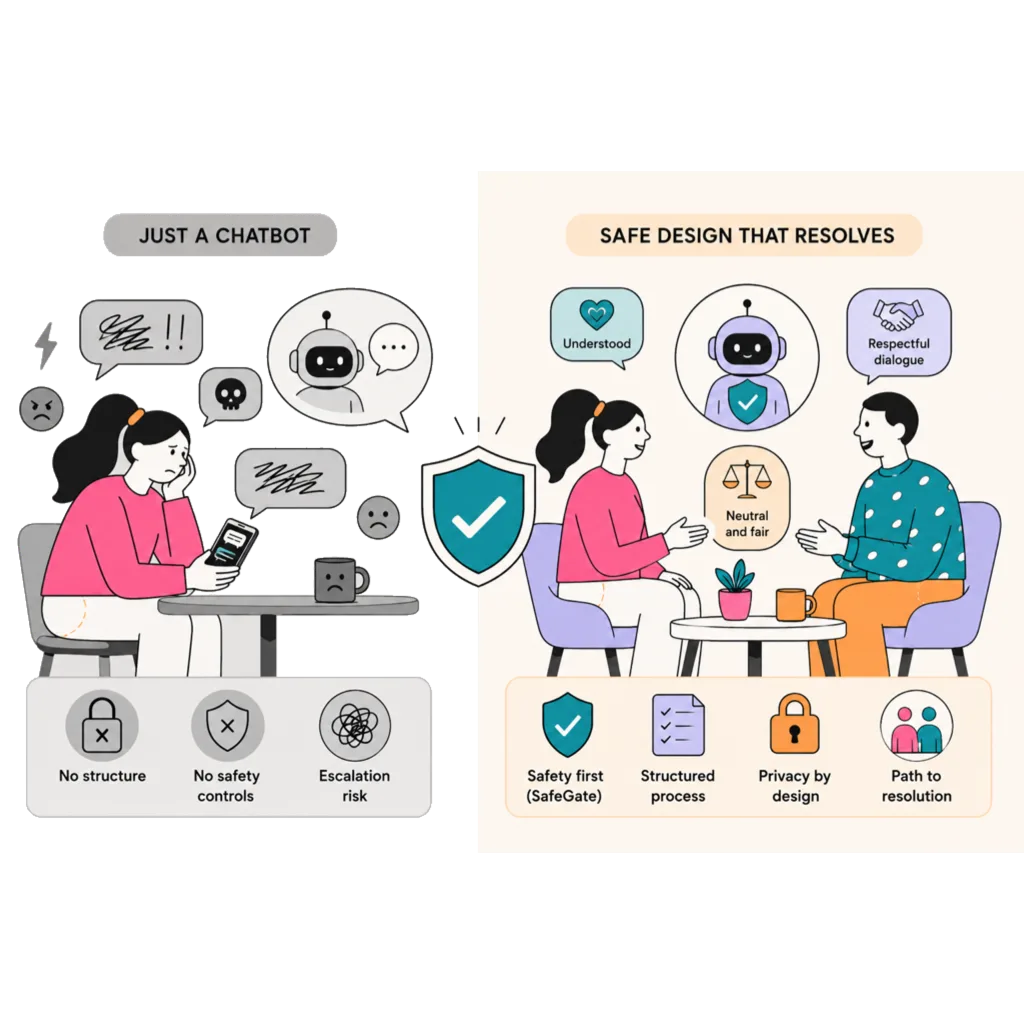

Why AI Mediation Is Becoming Technically Possible
Research source: Robots in the Middle: Evaluating LLMs in Dispute Resolution, Jinzhe Tan, Hannes Westermann, Nikhil Reddy Pottanigari, Jaromír Šavelka, Sébastien Meeùs, Mia Godet, Karim Benyekhlef, arXiv (cs.HC), October 2024.Why this paper matters
For years, AI mediation remained a theoretical promise—interesting to discuss, but unproven in practice. That changed with a groundbreaking study from researchers at the University of Montreal, Maastricht University, and Carnegie Mellon. By testing Large Language Models (LLMs) against human annotators across 50 dispute scenarios, the research provides empirical evidence that AI can handle core mediation tasks: selecting appropriate intervention types and drafting neutral, constructive messages.
This matters because it moves the conversation from "Can AI mediate?" to "How should AI mediate?"—a critical shift for platforms like TheMediator.AI that are building structured, consent-based mediation workflows.
The core finding
The study, "Robots in the Middle," evaluated LLM performance (using ChatGPT4o) against human annotators who were instructed using the Department of Justice Canada's Dispute Resolution Reference Guide. The results were striking:
- In 62% of cases, LLM-chosen intervention types were rated as better than or equal to human selections.
- In 84% of cases, LLM-generated mediation messages were rated as better than or equal to human-written messages.
- Evaluators found LLM messages more clear and smooth, less prone to misunderstanding disputes, and less likely to propose overly specific solutions or assign fault.
- No instances of hallucinations or harmful content were found in AI-generated messages.
The research demonstrates that LLMs can process dispute contexts, maintain neutrality, and generate impartial interventions—core capabilities for any mediation system.
What this means for AI mediation
For AI mediation platforms, this study validates the technical foundation. TheMediator.AI's approach—using AI to structure communication between consenting parties, suggest resolution paths, and maintain process integrity—aligns with what the research shows is now technically possible.
The study's finding that LLMs excel at generating neutral, clear messages without assigning fault is particularly relevant. TheMediator.AI's workflow is designed around this same principle: the AI facilitates dialogue and helps parties find common ground, but does not impose solutions or adjudicate fault. This isn't a limitation—it's a design choice that preserves party autonomy and procedural fairness.
SafeGate™ Reality Check
While the study found no harmful content in AI-generated messages, it's important to understand the boundaries. The research used 50 hypothetical scenarios evaluated by blinded human raters—not real-world disputes with actual parties experiencing high emotions, power imbalances, or safety risks.
This is exactly why SafeGate™ matters. In real disputes, the risk isn't just incorrect advice—it's coercion, threats, harassment, self-harm signals, or unsafe escalation entering the mediation record. The study's controlled environment didn't test for these dynamics, which is why TheMediator.AI incorporates safety layers that go beyond generating neutral text:
- Detection of coercive language, threats, or harassment
- Identification of power imbalances requiring human escalation
- Protections for vulnerable parties (including children)
- Human mediator fallback for complex or emotionally charged disputes
The research shows AI can handle the structured dialogue—SafeGate™ ensures the process remains safe.
What the paper does not prove
Despite its promising findings, the study has important limitations that prevent overclaiming:
- The human "mediators" were not professional mediators or legally trained—real mediators might perform differently.
- The study was limited to text-based messaging, not video, audio, or in-person mediation.
- Only 50 scenarios were tested—real-world deployment requires much larger scale.
- All interactions were in English with non-native speakers as human annotators.
- The study did not test multi-party disputes, which introduce additional complexity.
- Most importantly: the study does not prove AI can replace human mediators in complex, high-stakes, or emotionally volatile disputes.
LLMs showing competence in structured tasks is not the same as possessing the emotional intelligence, adaptability, and "room-reading" skills that experienced human mediators bring to difficult cases.
Product implications for TheMediator.AI
- Intervention type selection: Consider offering AI-suggested mediation intervention types based on dispute analysis, giving human mediators structured options.
- Message drafting assistance: LLM-generated messages can serve as templates or suggestions, helping mediators maintain neutrality and clarity.
- Neutrality by design: The research confirms that avoiding fault-assignment and specific solutions is a strength of LLMs—TheMediator.AI should double-down on this principle.
- Low-stakes focus: The study validates AI for routine disputes—aligning with TheMediator.AI's focus on everyday conflicts where quick resolution matters.
- Human-AI hybrid: Even as AI improves, the study suggests a hybrid model where AI handles routine tasks while humans manage complex dynamics.
Why this matters now
The convergence of three factors makes this research timely:
- LLM capability inflection: Models like GPT-4o have crossed a threshold where they can handle nuanced, context-dependent tasks like mediation interventions.
- Access to justice crisis: With 92% of civil cases settling out of court, and mediation backlogs growing, AI offers a path to scale dispute resolution.
- Consumer readiness: People increasingly trust AI for sensitive tasks, from mental health chatbots to financial advice—mediation is the next frontier.
The "Robots in the Middle" study provides the empirical foundation that investors, mediators, and platforms need. AI mediation isn't science fiction—it's a technically viable approach to improving access to justice, backed by rigorous evaluation.
Final takeaway
The research doesn't suggest AI will replace human mediators—it shows AI can handle structured mediation tasks with neutrality, clarity, and consistency. For platforms like TheMediator.AI, this means the technology is ready to scale dispute resolution for millions of everyday conflicts, while keeping human mediators in the loop for cases that require the irreplaceable human touch. The future isn't AI versus humans in mediation—it's AI and humans, each playing to their strengths.
Ready to see structured AI mediation in action? Start a mediation today and experience the difference.
Related Posts
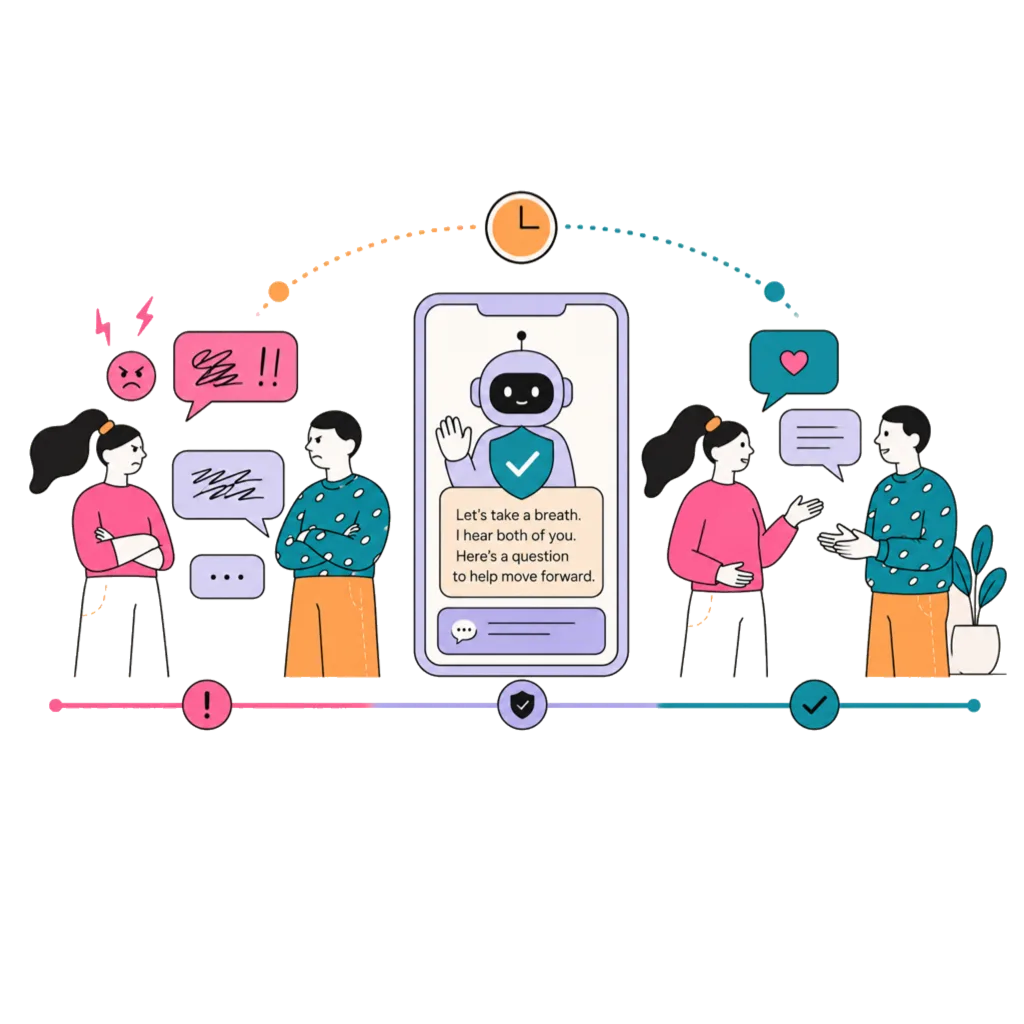
Why Proactive Intervention Timing Matters for AI Mediation Safety